
There is a kind of company where, during a meeting, someone drops a line in the group chat: “Let AI put out a first version of this,” and half an hour later a draft proposal is on the table; developers have AI read through the project before they start coding, designers generate twenty images first and then pick, and the customer service script library is updated once a week by AI. In these companies, AI is not a website you need to open, but a layer that is right there at hand while you work.
In another kind of company, the situation is almost the opposite. The boss heard that AI can write proposals, so had admin register an account, tried it twice, and thought, “It’s just so-so”; employees occasionally toss a question into the chat box and ask a couple of things, get a safe, well-rounded paragraph, copy half and edit half, and in the end still write it themselves. Six months later, the way they work has not changed at all.
This divergence is not an illusion. Over the past two years, several mainstream institutional surveys have repeatedly pointed to the same cross-section: the “use” of AI has become very widespread, but “seeing results” is still something only a minority achieve.
1. There is a wide gap between popularization and returns.
McKinsey's 2026 global AI adoption survey covered 97 markets and more than 1,700 executives. The results show that 89% of companies use AI regularly in at least one business function, 56% use it in three or more functions, and 44% have achieved enterprise-wide scaled deployment.
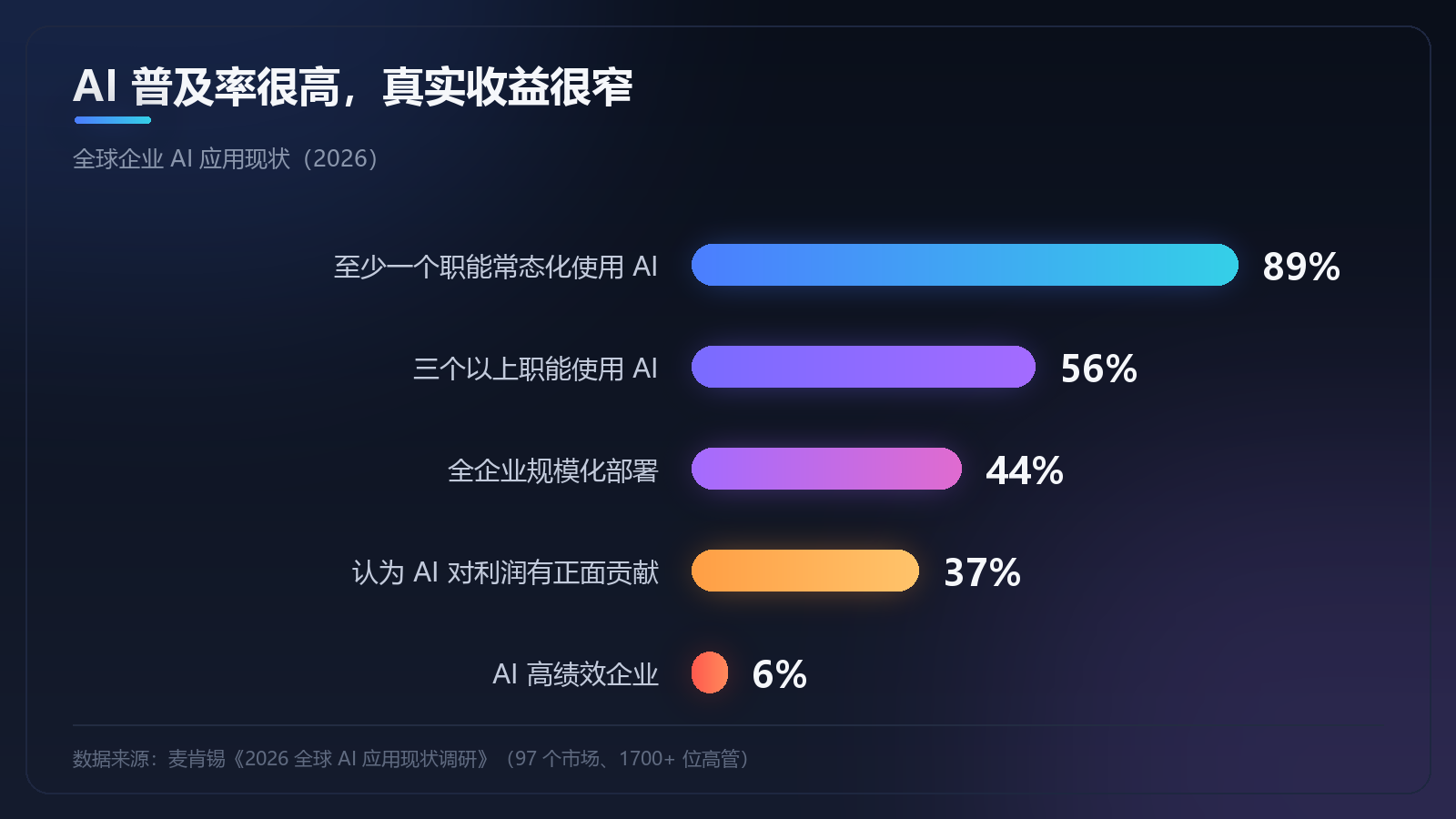
But look at the next two metrics, and the picture changes: only 37% of respondents believe AI makes a positive contribution to their company's EBIT; and only 6% are defined as "AI high performers"—with at least 5% of profit growth attributable to AI.
From 89% to 6%, what lies in between is not willingness, nor budget. The same survey contains two more numbers: high-performing companies are nearly three times as likely as other companies to completely redesign their workflows; and 48% have their top leader personally driving the AI agenda, compared with only 16% of other companies.
The gap is not about whether AI is used, but whether things are changed.
II. Scale is the first watershed.
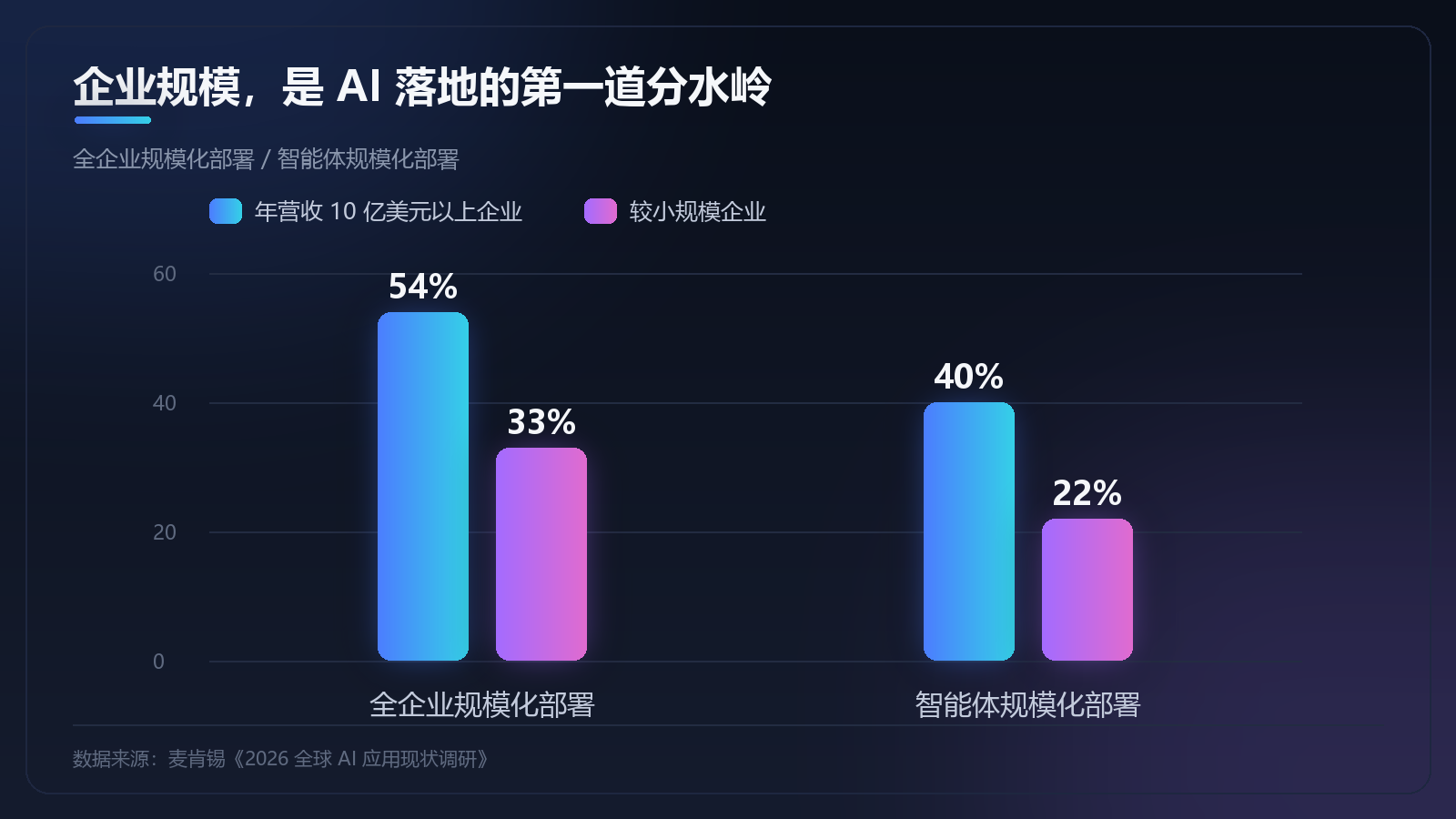
Among companies with annual revenue of more than $1 billion, 54% have achieved enterprise-wide deployment at scale, while only 33% of smaller companies have. In the newer area of AI agents, the gap widens further: large enterprises rose from 27% to 40%, while small businesses stayed at 22%, with almost no change over the year.
These figures are often read as “small companies have no money and no talent.” But the real difference is often more ordinary: large enterprises have dedicated teams to change processes, set standards, and review the work; in small businesses, AI is usually just something one person uses on the fly and drops afterward, leaving no institutional practice behind.
III. The data on Chinese enterprises is more direct: high usage, limited results.
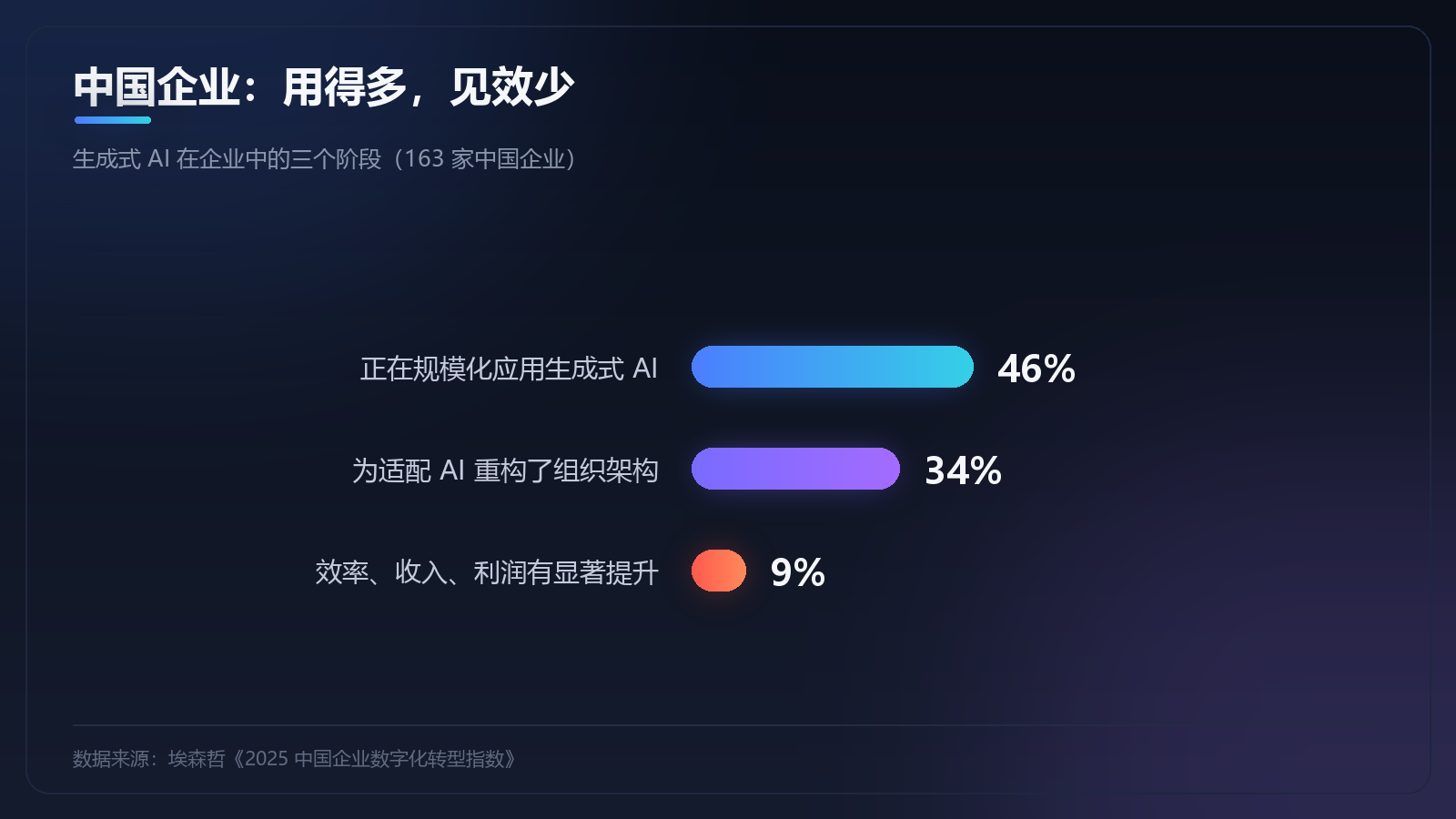
Accenture's "2025 China Enterprise Digital Transformation Index" surveyed 163 Chinese enterprises: 46% are scaling generative AI, and 34% have restructured their organizations to adapt to AI, but only 9% have achieved significant improvements in efficiency, revenue, and profit.
The sentiment on the employee side aligns with this figure. In another Accenture survey covering 20 countries, 3,650 executives, and 3,350 employees, 52% of Chinese employees said that low-quality or misleading AI output led to wasted time and reduced efficiency; only 12% of employees strongly agreed that "the company has clearly communicated its vision for change for 2026."
Executives are discussing strategy, while employees are being drained by poorly functioning output. This is the most typical picture of the intermediate state: tools have been distributed, but the systems have not kept up, and in the end, frontline time pays the price.
IV. The "people" layer in the middle takes up most of the revenue.
It is easy for one person to improve efficiency with AI: writing copy, organizing meeting notes, looking up information, and modifying code can show results the same day. But efficiency gains at the organizational level do not happen automatically. In between is “people”—people take results from AI, judge them, move them, correct them, and then hand them off to the next step.
If this layer of manual handoff does not disappear, the organization's efficiency ceiling is capped by this person; when the person takes leave or leaves the company, the capability goes with them, because the capability has not been embedded into processes and systems.
This also explains why in many companies “everyone is using AI,” yet the company as a whole has not become faster: they treat AI as a smarter search box rather than a work step that needs to be re-partitioned.
V. Several Questions for Self-Assessment
- When a new hire joins, is there a clear standard procedure for "how to use AI," or do they have to figure it out on their own?
- Are product materials, customer cases, and internal guidelines organized into a form that AI can directly read and cite?
- Is there a fixed review process and set of criteria for AI outputs?
- Is there any business process that would noticeably slow down, or even become impossible, without AI?
If the answer to the first three is "No," you are still outside the door; only if the answer to the fourth is "Yes" have you truly stepped inside.
Six, two signals seen from the matter of website building
After all these years of building corporate websites, the changes in what clients ask for say a lot.
A few years ago, clients asked, “Does the page look good? Can we add a few more sections?” Over the past two years, more and more clients have started asking a different kind of question: Can our content be found by AI, and can it be cited? When customers come asking at midnight, is there something that can field their questions first?
These two questions look like technical issues, but at heart they point to the same judgment: whether a company has begun to organize its own knowledge and information into a form machines can also use.
The official website is the most basic starting point for this. A site with clear structure, real content, and explicit semantics is itself a knowledge draft that the company presents to the outside world—regardless of whether the visitor is a person or AI. Conversely, a website full of images, with only a few slogans as body text and a chaotic section structure, gives neither people nor machines anything to read.
AI customer service is the minimum viable step. It does not require transforming the entire organization; it only requires you to truly understand and accurately answer the dozens of questions customers ask most often. Many companies, in the process of doing this, sort out their own business knowledge clearly for the first time—and this by-product is more valuable than the customer service itself.
7. No need to get everything right in one step, but you must take the first step
The polarization sounds like a gap in technical capability, but it is actually a gap in organizational learning speed. What makes this round of AI special is that it does not reward what you bought—only what you changed.
For companies that have not yet started, there is no need to begin with comprehensive intelligentization. Pick the process with the highest degree of repetition and the clearest criteria for judgment—customer service Q&A, first drafts of content, or information retrieval all work—and ensure that “it must be completed through AI, and someone is accountable for the results.” Only by taking this step can you truly leave the chat box.
For the end of the spectrum that can no longer do without AI, the next question is not “where else can it be used?” but “which capabilities should be built into organizational assets rather than remain in individuals’ hands?”
Two years from now, the divide may not be between using AI or not, but over whose organization AI actually grows within.
Data Description
The data in this article comes from McKinsey's "2026 Global AI Application Status Survey" (97 markets, more than 1,700 executives), Accenture's "2025 China Enterprise Digital Transformation Index" (163 Chinese enterprises), and Accenture's 2026 "Pulse of Change" survey (20 countries, 3,650 executives and 3,350 employees). All are questionnaire survey results and reflect companies' self-reported data.