
The entry point to search has shifted from a page of results to a paragraph of answers.
In the past, finding a supplier went like this: you entered “Xi'an website development” into the search box, a page of blue links appeared, you scrolled down, clicked into the ones whose names looked appealing, checked whose pages looked decent and whose case studies matched, and then made a phone call.
Now many clients don't do that anymore. They open Doubao, Yuanbao, or DeepSeek and directly ask, “Which companies in Xi'an that build corporate websites are relatively reliable?” The AI gives a paragraph, names three or four companies, explains what each is good at, and sometimes adds, “It is recommended to prioritize service providers with manufacturing case studies.” After reading this answer, a person may not click a single link and may contact them directly.
The core of the change is one sentence: The entry point has changed from “a page of results” to “a paragraph of answers.”
Who sees you no longer depends on which position you rank in, but on whether the AI includes you when it organizes its answer.
Baidu Index has charted this.
The blue line is seo, the green line is geo, and the time span runs from December 2023 to November 2026.
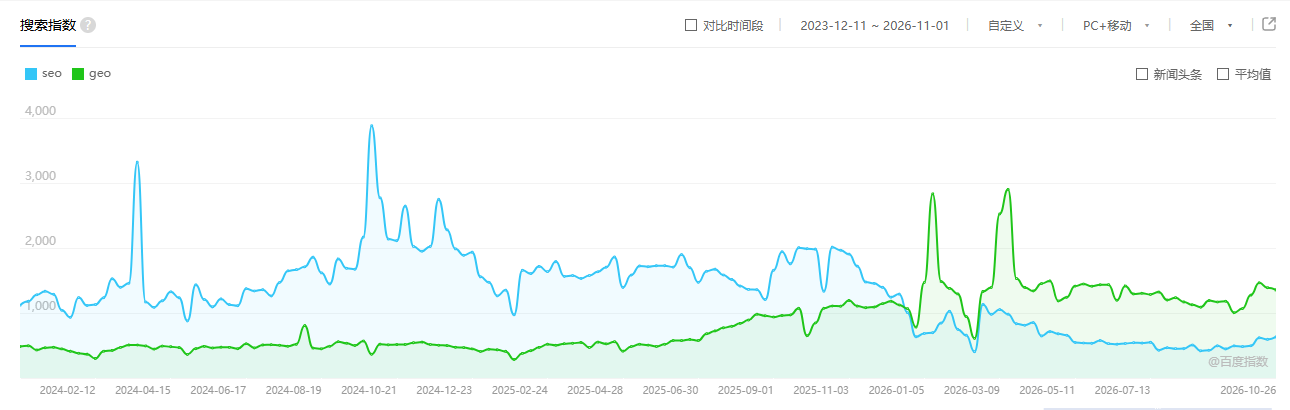
Throughout 2024, geo ran almost along the bottom — back then, AI was still at the "have a quick chat" stage. In the second half of 2025 the green line began to climb, and at the end of 2025 and the start of 2026 it hit two clear peaks, after which it fell back to a level that isn't high, but is now sitting steadily above the blue line. Meanwhile, after the blue line spiked to a peak in October 2024, it has been sliding steadily downward since the autumn of 2025.
The crossover point is roughly February or March 2026.
One thing to note: these two lines are the search popularity of English keywords in Baidu Index, reflecting where the attention of practitioners and observers is heading, not an absolute measure of market size. But the direction of the trend is clear: over two years, the people talking about this have switched their keyword from SEO to GEO.
AI has been hot for two years, and it has just reached the third step.
Looking back at the past two years, enterprises' use of AI has actually gone through three stages.
The first stage was from 2023 to 2024, when everyone was learning how to talk to AI. Writing a product introduction, revising an email, translating a manual—AI was something that replaced search and scratch paper.
The second stage is 2025, when AI began to really do the work. Writing code, making images, producing spreadsheets, analyzing data—it became toolized and embedded in workflows, and many people can't get through a workday without opening it.
The third stage is now. People are starting to ask AI to help look things up and help make judgments. What equipment to buy, which supplier to find, whether this plan is reliable—they ask AI first. At this point, AI is no longer just a tool; it has become an entry point.
GEO is the product of the third stage. In the first two stages, AI helps you do things; in the third stage, AI decides who you see first. The shift in attention from SEO to GEO is essentially attention moving along with the entry point.
Companies' focus has shifted from "where do I rank" to "am I even there"
I have seen many owners of manufacturing companies who have to look at a ranking report once a month: where a certain keyword ranks, and whether it has risen or fallen compared with last month.
The question itself is not wrong, but it assumes one premise: customers will scroll through the list. When customers start asking AI, the question turns into something else:
When AI is asked "Which domestic manufacturers make mechanical seals?", are you in the answer?
These two questions are not on the same level. "What rank do I have?" competes for position; "Am I there?" competes for existence. If you rank lower, you can still be found by scrolling; if you do not exist, you have absolutely no chance of being seen.
What GEO optimization actually optimizes is not mysterious at all.
Many people describe GEO as a new algorithm or a new set of tricks, making it sound like mysticism. It is actually not that mysterious.
When AI generates answers, it relies on materials it can retrieve, understand, and cite. So what optimization needs to do is turn your content into “good material.”
The first thing is to make AI understand who you are. What products you make, what specifications, which industries you serve, and what regions you cover must be clearly stated, rather than hidden behind several paragraphs of lyrical copy.
The second thing is to have verifiable facts. Year of establishment, production line scale, testing capabilities, delivery cycles, and typical cases—these are what AI is willing to cite. “Industry-leading,” “trustworthy,” and “total solution provider”—neither people nor AI can extract any information from these words.
The third thing is to have your own judgment. A passage that clearly states “under what circumstances A should be chosen and when A is not suitable” is more likely to be cited than ten adjectives, because it can be used to draw a conclusion.
What should be changed first is not the algorithm, but the content.
For example. On the homepage of a company that supplies supporting equipment for a certain project, the first sentence is “Committed to becoming an industry-leading provider of overall solutions.” Ten years ago, this was standard phrasing, but today it conveys almost zero information.
What should it be changed into? Make it clear in one sentence: what product you make, what specification range it covers, what type of customers it is for, how long the delivery cycle is, and what precision you can achieve. After the change, this readable, extractable, and citable sentence will be far more useful than studying “what tips there are for GEO.”
There are no shortcuts when it comes to content. The entry point for search has indeed shifted from lists to answers, but taking content seriously has always been an unchanging prerequisite.