
Several documents all talk about the same matter.
Over the past few months, several documents are worth reading together.
One is the "Plan for Promoting the Development of Small and Medium-sized Enterprises (15th Five-Year Plan)", jointly issued by ten departments. It specifically includes the "Special Action for the Digital and Intelligent Transformation of SMEs", which explicitly calls for cultivating a batch of "small, fast, lightweight, and precise" digital and intelligent products and solutions.
Another is the "Guidelines for Cultivating 'Small, Fast, Lightweight, and Precise' Digital Products and Services (2026 Edition)" released by the Ministry of Industry and Information Technology in July, which officially breaks down the term "small, fast, lightweight, and precise" into miniaturization, rapidization, lightweighting, and precision.
There is also the "Opinions on Accelerating Science and Technology-Enabled Commerce" issued in October by the Ministry of Commerce and eight other departments. It contains 18 measures, including a tone-setting statement: large enterprises build platforms, tackle technologies, and set demonstrations; SMEs use tools, enjoy services, and expand markets.
The documents are different, and the departments are different, but they point to the same thing: enabling SMEs to use digital tools at low cost and with a low threshold.
Small, quick, light, and precise, which means low cost to start, fast to roll out, easy to run, and aimed at exactly what you need.
These four terms are policy language; put into words that company owners can understand, they are actually very simple.
Small-scale means don't be greedy for too many features—solving one problem is enough; fast means it can be used today—don't launch a big project that drags on for months; lightweight means you don't need to maintain a technical team or understand code; precise means it fits exactly your industry and your scenarios, not forcing a one-size-fits-all, all-encompassing solution onto you.
Put together, it comes down to one sentence: let an ordinary boss with no technical background use digitalization on their own.
Why do policies focus on small and medium-sized enterprises?
Because it involves the largest number of people, and it is also the hardest.
In the data from the Fifth National Economic Census, there were nearly 56 million individual businesses in the wholesale and retail, and accommodation and catering sectors alone. For these entities to go digital, what they need is not a system costing hundreds of thousands, nor a technical team, but a tool they can use right away.
There has long been a saying in the industry about the digitalization of SMEs: “unwilling to transform, afraid to transform, unable to transform.” Unwilling to transform means seeing no returns; afraid to transform means fearing that the money will be wasted; unable to transform means lacking technology and people.
These three problems actually all point to the same root cause: the threshold for using tools is too high. Once the threshold is lowered, all three problems can be eased together.
What we do happens to stand right on this line.
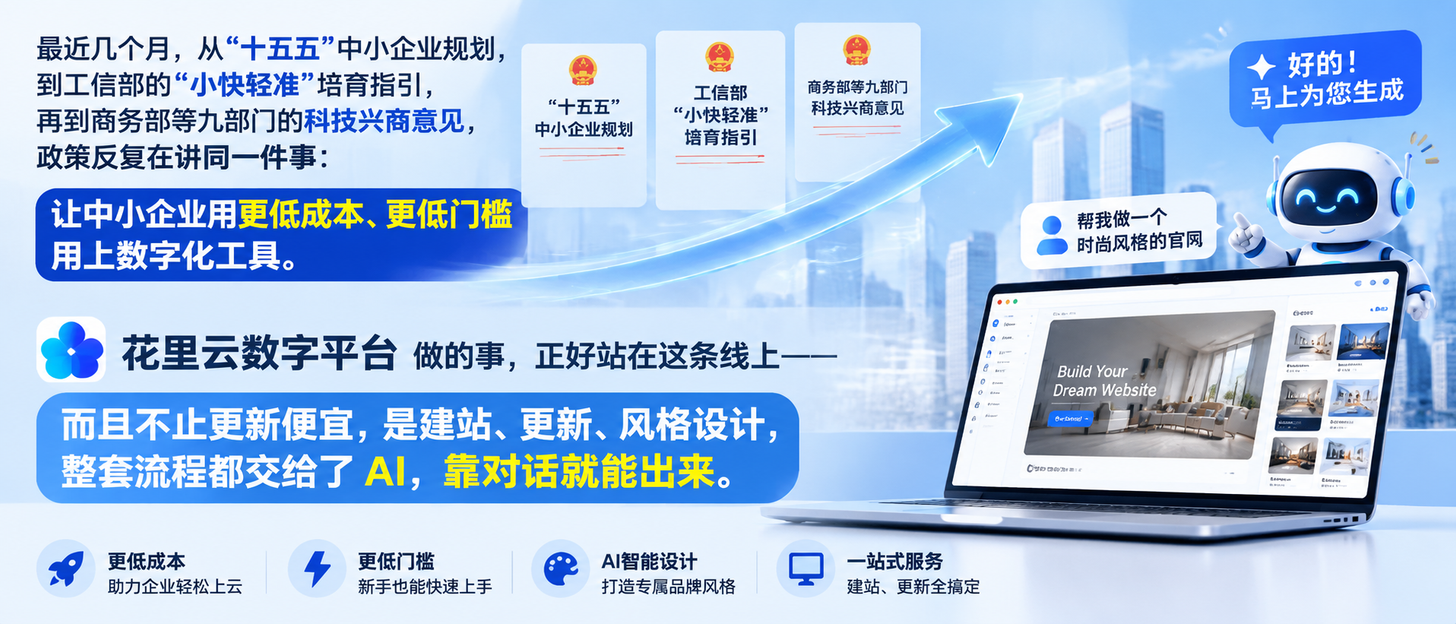
The HOLYPro digital platform is doing exactly this.
But what I want to talk about today is not just the “affordable updates” aspect. If we compare the policy’s “small, fast, light, and precise” with our products, we’ll find that our understanding is a bit more complete than that.
It's not just that updates are cheap; the entire process has been handed over to AI.
Many enterprises still think that building a website requires understanding design, code, and a pile of professional jargon. Actually, that’s not necessarily true.
Our approach is to let AI run through the entire process of website development, website updates, and style design. Enterprises don’t need to understand that specialized knowledge; they just need to explain their needs clearly through conversation, and AI will take structure, layout, style, and functionality into consideration together, creating a beautiful, effective website whose functions meet the enterprise’s needs.
After it’s built, updates follow the same logic. Products change, case studies increase, the address moves—you can make changes yourself in the backend through conversation, without asking for help or waiting for a schedule.
With this whole setup, “small-scale, fast, lightweight, and precise” is no longer just a policy slogan, but something enterprises can actually touch and feel.
Policy sets the direction, while products provide the stepping stones.
The policy has made the direction clear: for SME digitalization, the threshold must be low, and the tools must be easy to use.
But direction is one thing—companies ultimately have to land on a specific tool. What we do is offer, in this direction, a step that can be stepped onto immediately.