

Website

TUNBEE: Framing a procurement agent as a verifiable supply chain

A China-based procurement service provider for overseas buyers, developers, and hotel projects. This site is not about looking professional; it is about convincing a buyer half a world away that the quotes are real, the factories have been visited, and someone is keeping an eye on the goods.

Guangzhou Tunbee Import And Export Co., Ltd. Guangzhou Launched 2026-10-18
TUNBEE: Framing a procurement agent as a verifiable supply chainTUNBEE: Framing a procurement agent as a verifiable supply chain
ClientGuangzhou Tunbee Import And Export Co., Ltd.
Industry & TraitsWebsiteForeign TradeConstruction
RegionGuangzhou
Launched2026-10-18
Delivery TeamXiXi

Customers and Tasks

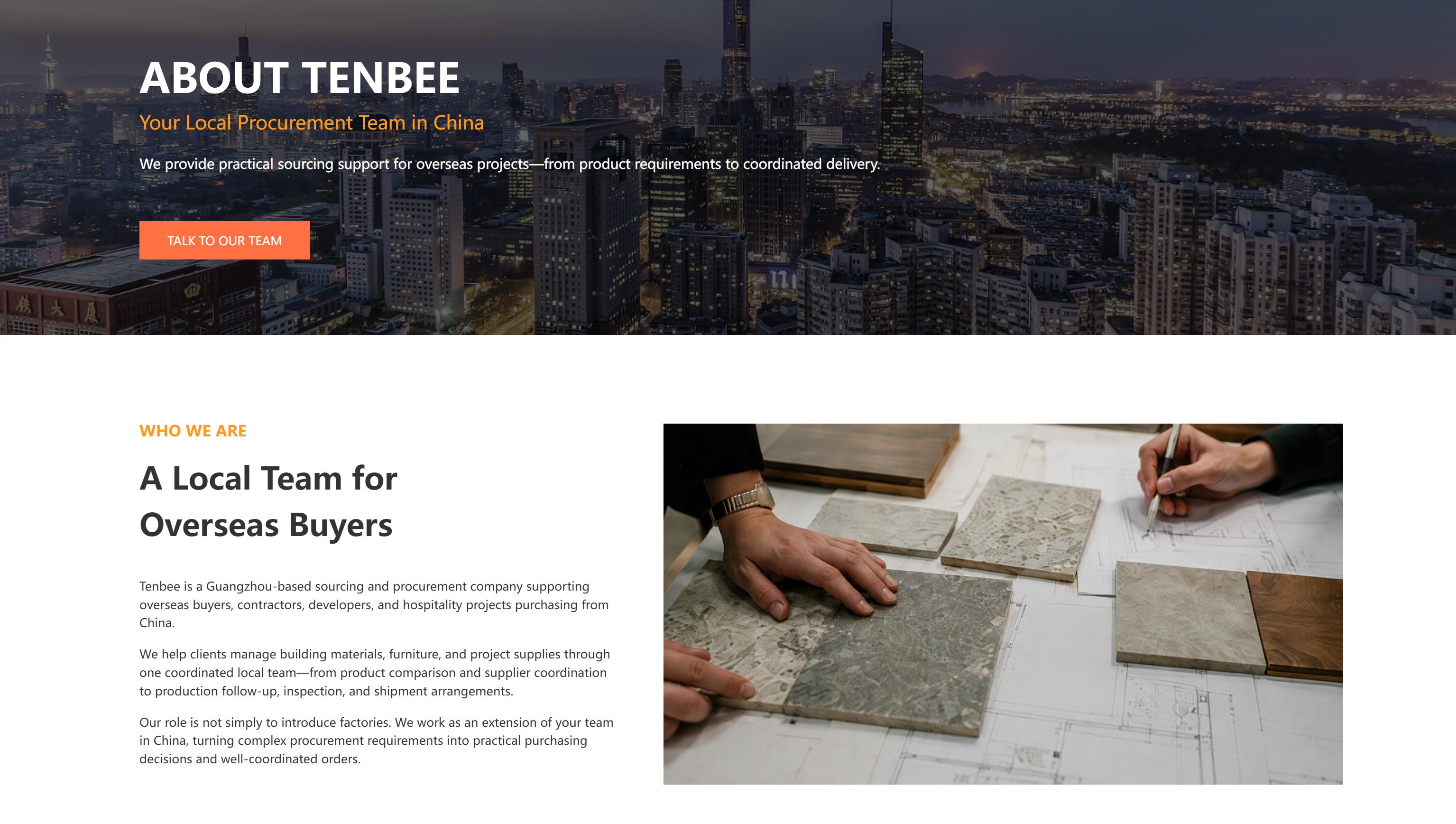
TUNBEE is a Guangzhou-based sourcing and export services company serving overseas clients—hotel developers, construction contractors, interior design firms, and traders. They buy building materials, furniture, lighting, sanitary ware, and hospitality supplies from China. The challenge is not "finding a factory," but that "no one can judge on your behalf which factory can deliver."

So this website has a very specific job to do:

  • Make buyers understand within two screens that TUNBEE is the one executing on the ground in China for them, not just another quotation broker.
  • Clearly define the boundaries of our capabilities: which categories we cover, which stages we manage, and what we do not handle.
  • Give hesitant buyers a low-barrier path—ask for a quote first, inspect a factory first, have a conversation first.
t2.jpg

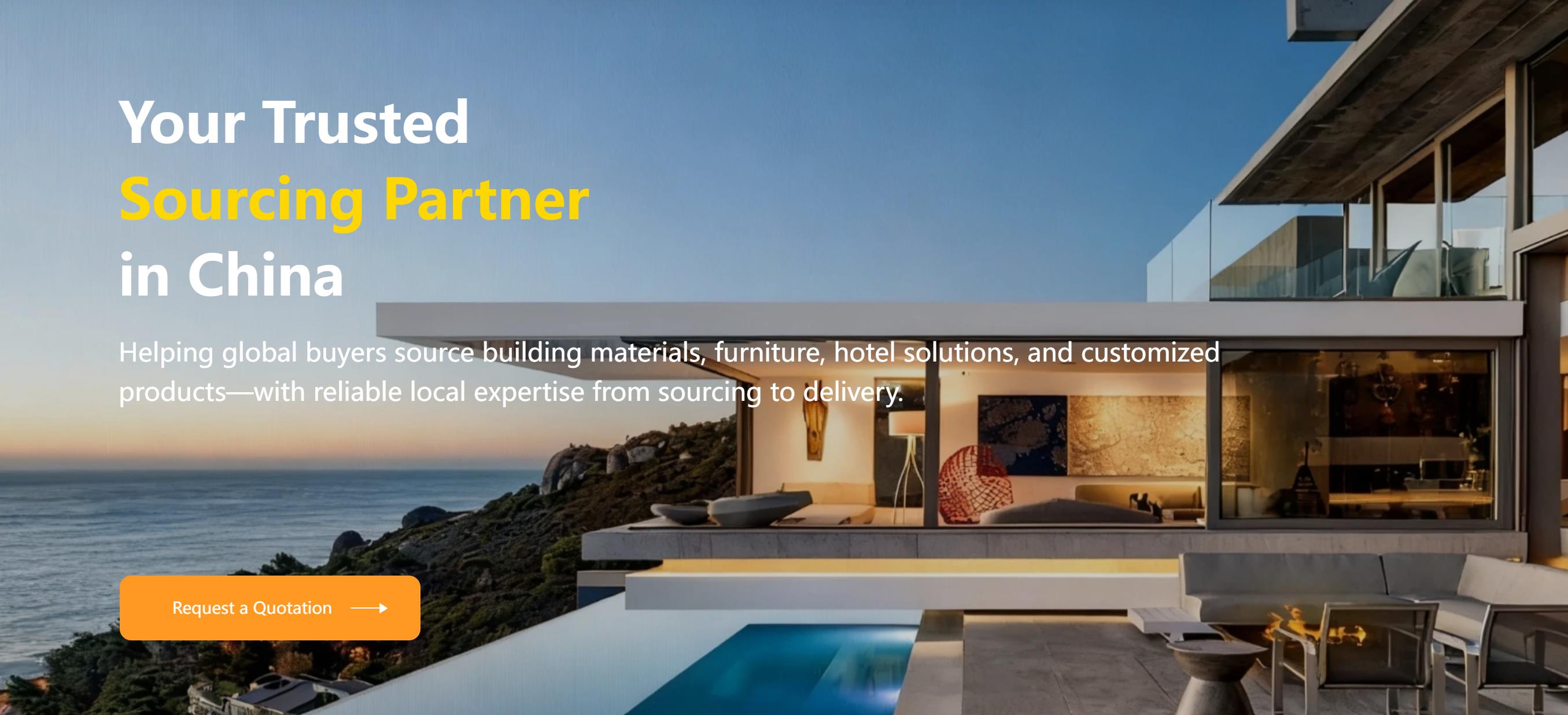
Above the fold: identity first, then scope.

The first screen does only one thing: one sentence to establish identity, and one sentence to define scope.

The proposition is "Your Trusted Sourcing Partner in China", immediately followed by a sentence on capability scope—building materials, furniture, hotel solutions, and custom products, from sourcing to delivery, executed by a local team.

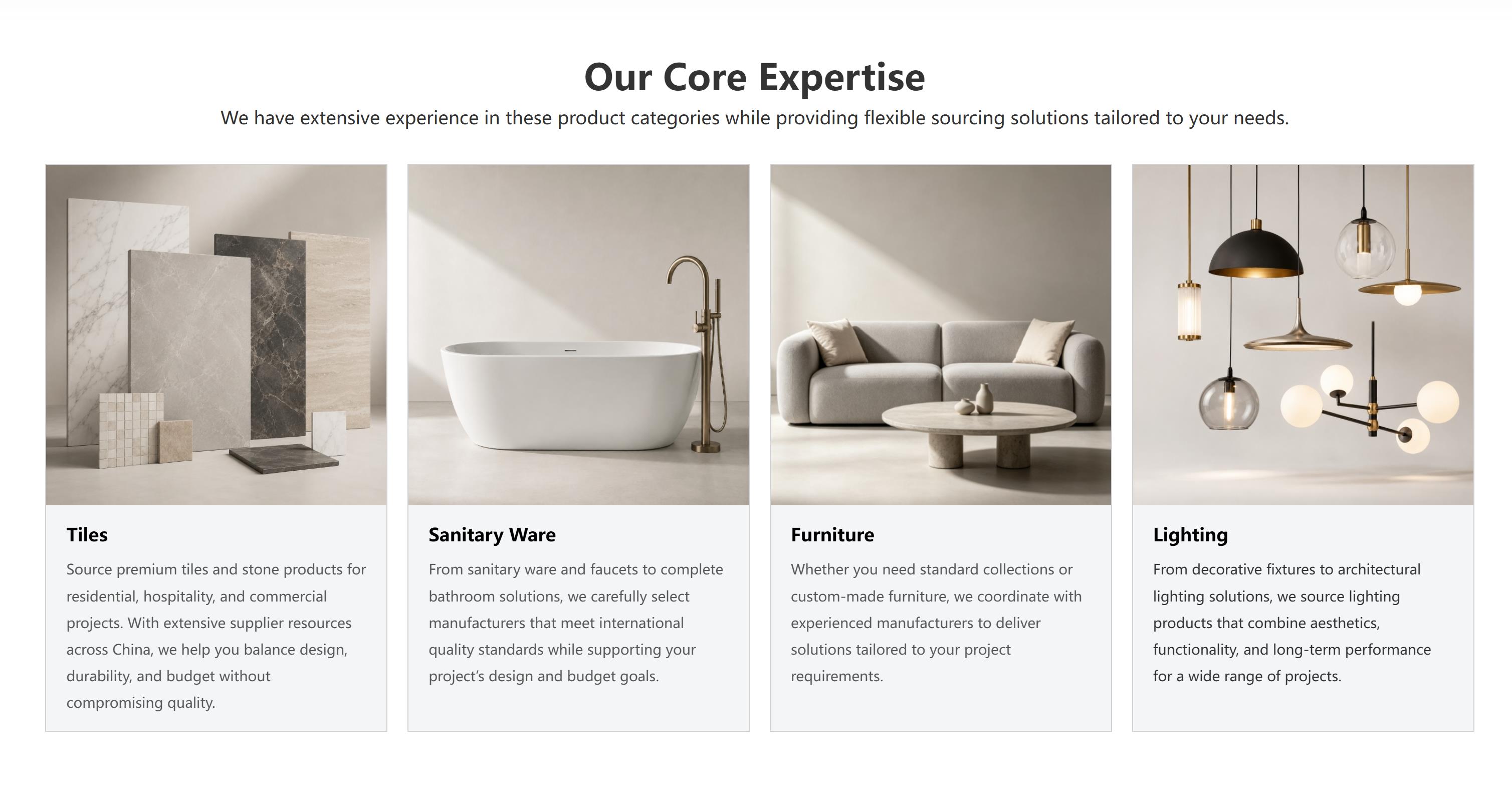
The right side uses product vocabulary rather than adjectives: Tiles, Sanitary Ware, Furniture, and Lighting are laid out directly, with each category accompanied by a sentence on "how we select factories and control budgets." What buyers care about is exactly these three things: whether the design can be implemented, whether quality is stable, and whether the budget can be kept under control.

There is only one primary button: Request a Quotation. There is no second parallel button, to avoid splitting focus on the first screen.

t3.jpg

One homepage covers it all: capabilities, evidence, problems, entry points.

The order of information on the homepage is deliberately arranged:

  1. Four core categories—first let buyers confirm “you are the expert in what I want to buy”
  2. A positioning statement—local Guangzhou team, direct factory connections, covering the full process from factory selection to shipment
  3. Four service lines—China Sourcing Solutions / Design & Procurement / Quality Management / Consolidation & Logistics
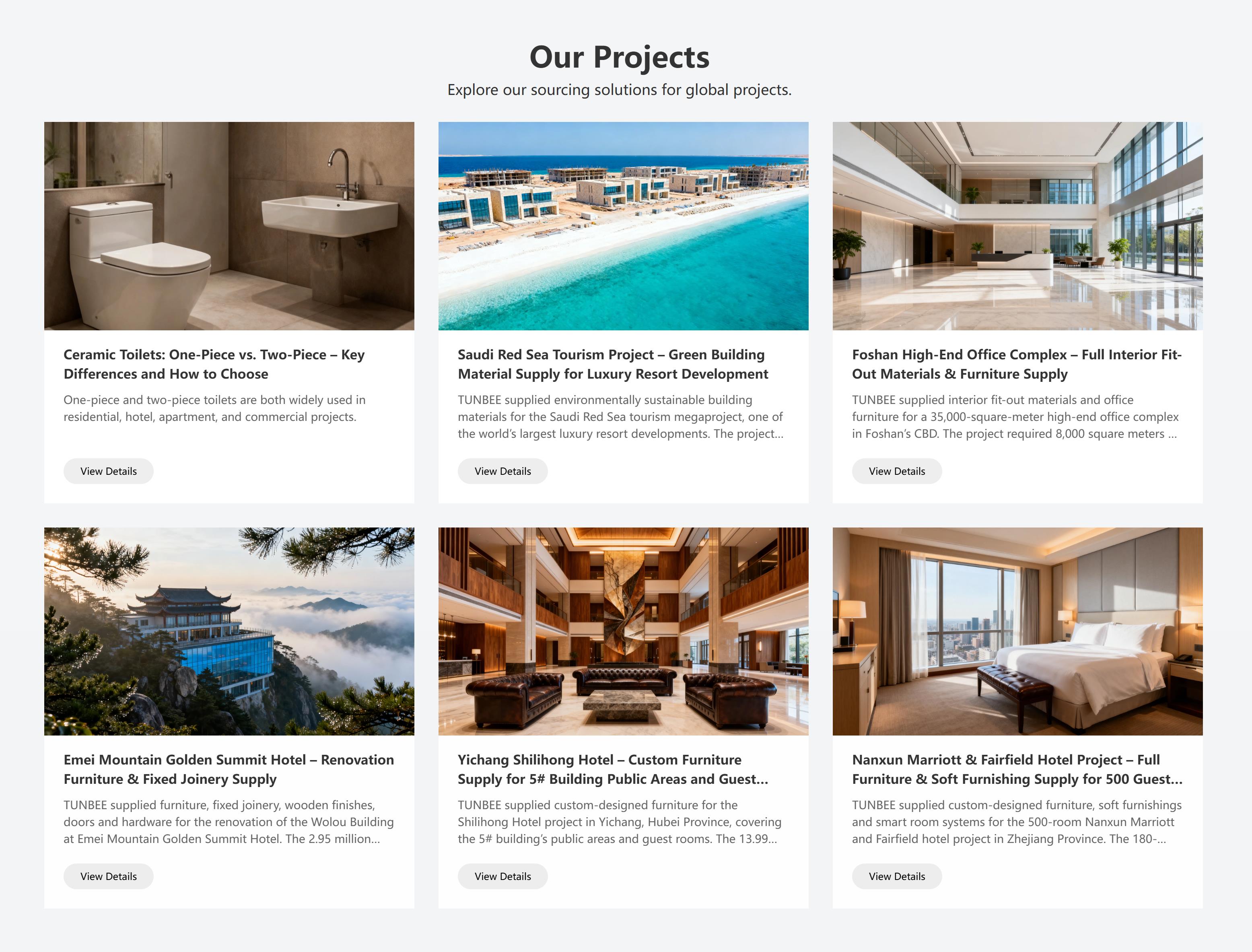
  4. Four real projects—Saudi Red Sea tourism project, Foshan office full renovation, Emeishan Golden Summit hotel renovation, Yichang and Nanxun hotel furniture
  5. FAQ—answer the five questions buyers ask most often upfront: scope of services, factory reliability, whether factory visits are possible, whether they only do building materials, and whether they can provide interpretation accompaniment only
  6. Contact entry—WhatsApp, email, address, all clickable

One trade-off worth mentioning: the FAQ directly states interpretation accompaniment at USD 80/day and chartered car at USD 70/day. Such explicit pricing is rare on B2B sites, but it addresses overseas buyers’ most fundamental concern—“first ask whether I will be led into a quotation trap.” Price transparency is a trust tool in this industry, not a price war.

t4.jpg

Evidence: Projects are more useful than adjectives.

Five projects are featured on the homepage in varied formats:

  • Saudi Red Sea Tourism Project — green building materials supply, with scale presented by regions, islands, and hotel count
  • Foshan Office Building Turnkey Fit-out — 35,000 sqm, 8,000 sqm of tiles, 1,200 workstations, delivered in 60 days
  • Emeishan Golden Summit Hotel Renovation — RMB 29.5 million, furniture, fixed furniture, wood veneer, doors and hardware, delivered to an altitude of 3,077 meters in 130 days
  • Yichang Shilihong Hotel — RMB 13.99 million, four categories of furniture: wood, stone, upholstered, and glass, delivered and installed in 50 days
  • Nanxun Marriott and Four Points by Sheraton — 500 guest rooms, furniture, soft furnishings, and guest room smart control

These figures are the hardest part of the site: area, number of rooms, amounts, days, and altitude. Buyers do not need adjectives; they need to know “you have done projects of similar scale.”

t5.jpg

Design Notes

Information density over whitespace. This is a procurement site, not a brand image site. Buyers arrive with specific questions: can you make it, how much does it cost, how soon can it arrive. Pages may be dense, but every block must have a clear heading so it can be located by scanning.

Categories use buyers' words, not industry words. Navigation goes straight to Floor, Wall & Ceiling, Doors & Windows, Sanitary Ware, Cabinetry, Lighting—not internal phrases like "Building Materials Division."

Inquiries don't go through a single entry point. INQUIRY at the top, Online Inquiry within the page, a floating WhatsApp button, and an email in the footer—four routes all reach a person. Overseas buyers' habits vary widely: some trust only email, some only send WhatsApp.

Projects and knowledge base are kept separate. Our Projects holds delivery evidence; Knowledge Base holds product selection knowledge (such as the difference between one-piece and two-piece toilets). The former builds capability, the latter builds professionalism, and it also gives the site a reason to keep updating.

Mobile trims down in order. On mobile, the first screen keeps only the proposition, the scope, and the primary button; categories and services collapse into horizontal cards; Projects and FAQ keep their order—what buyers most want to confirm on a phone is still "what have you done."

t6.jpg