

Website

Building materials foreign trade website: categorize products by use and give quality inspection reports a separate section.

A foreign trade company in Linyi dealing in plywood, construction formwork, and wood-plastic panels, with contractors and wholesalers across five continents as its customers. This type of site is most easily turned into a product catalog; two moves pulled it back: products are categorized by use rather than by material, and quality inspection was separated from services into its own section.

WJ-WAY JOY Linyi, Shandong Launched 2026-10-25
Building materials foreign trade website: categorize products by use and give quality inspection reports a separate section.Building materials foreign trade website: categorize products by use and give quality inspection reports a separate section.
ClientWJ-WAY JOY
Industry & TraitsWebsiteForeign TradeCross-border
RegionLinyi, Shandong
Launched2026-10-25
Delivery TeamXiXi

The most common classification mistake in this industry is categorizing products by material.

A foreign trade company specializing in plywood usually writes its product navigation like this: poplar plywood, pine plywood, birch plywood, then further divided by thickness and glue grade.

That is the factory’s taxonomy—classified by raw material and process.

But overseas buyers don’t think that way. Those buying formwork care about whether it can be reused twenty times; those buying cable drums care about whether they can withstand several tons of cable without falling apart; those buying door core boards care about whether grooving will cause edge chipping. What they are buying is application, not wood.

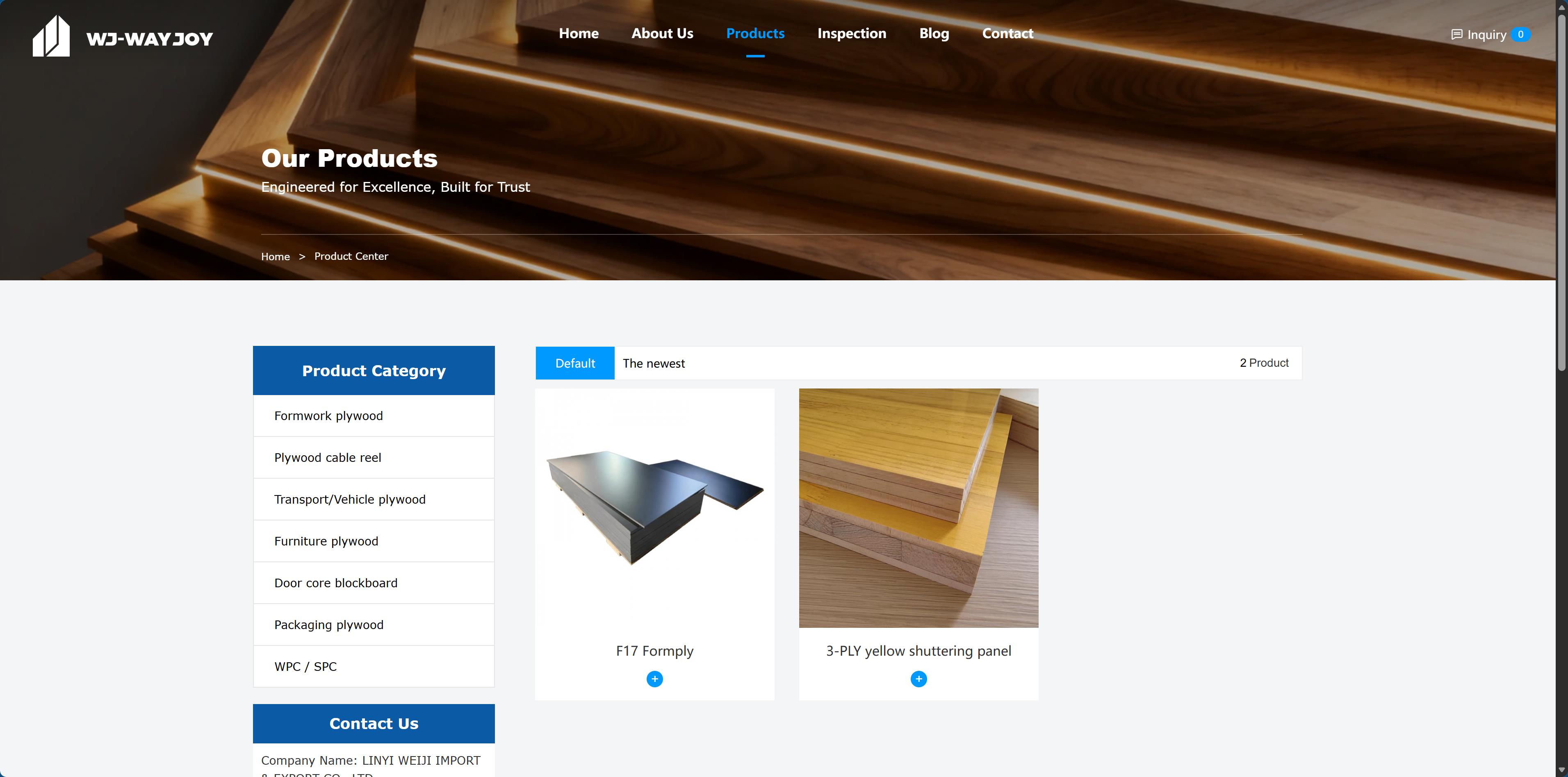
This site’s product navigation is: construction formwork, cable drum boards, truck body / transportation boards, furniture boards, door core boards, packaging boards, plus a separate wood-plastic / stone-plastic wall panel line.

For the same batch of plywood, sorting by material gives you only one price list; sorting by application gives you six separate positions where you can make your case.
2026071000443956c0a9.jpg

The six terms in the secondary navigation represent six procurement logics.

If you break the six categories down, you'll find that behind them are six types of people and six sets of judging criteria:

  • Building formwork: Engineering contractors. They look at turnover cycles, release performance, and board surface flatness.
  • Cable reels: Cable manufacturers. They look at load-bearing capacity, inner hole precision, and batch consistency.
  • Vehicle body / transport panels: Modification shops. They look at bending resistance, moisture resistance, and lightweighting.
  • Furniture panels: They look at veneer, formaldehyde grade, and color difference.
  • Door core panels: They look at density and grooving performance.
  • Packaging panels: They look at price and lead time, and hardly consider brand at all.

This level of categorization is not just on-site navigation; it also determines whether the site can be picked up by different search entry points: overseas buyers search for formwork plywood supplier, not poplar plywood manufacturer.

Naming by use is equivalent to attaching each category's search terms directly to the navigation.

wj5.jpg

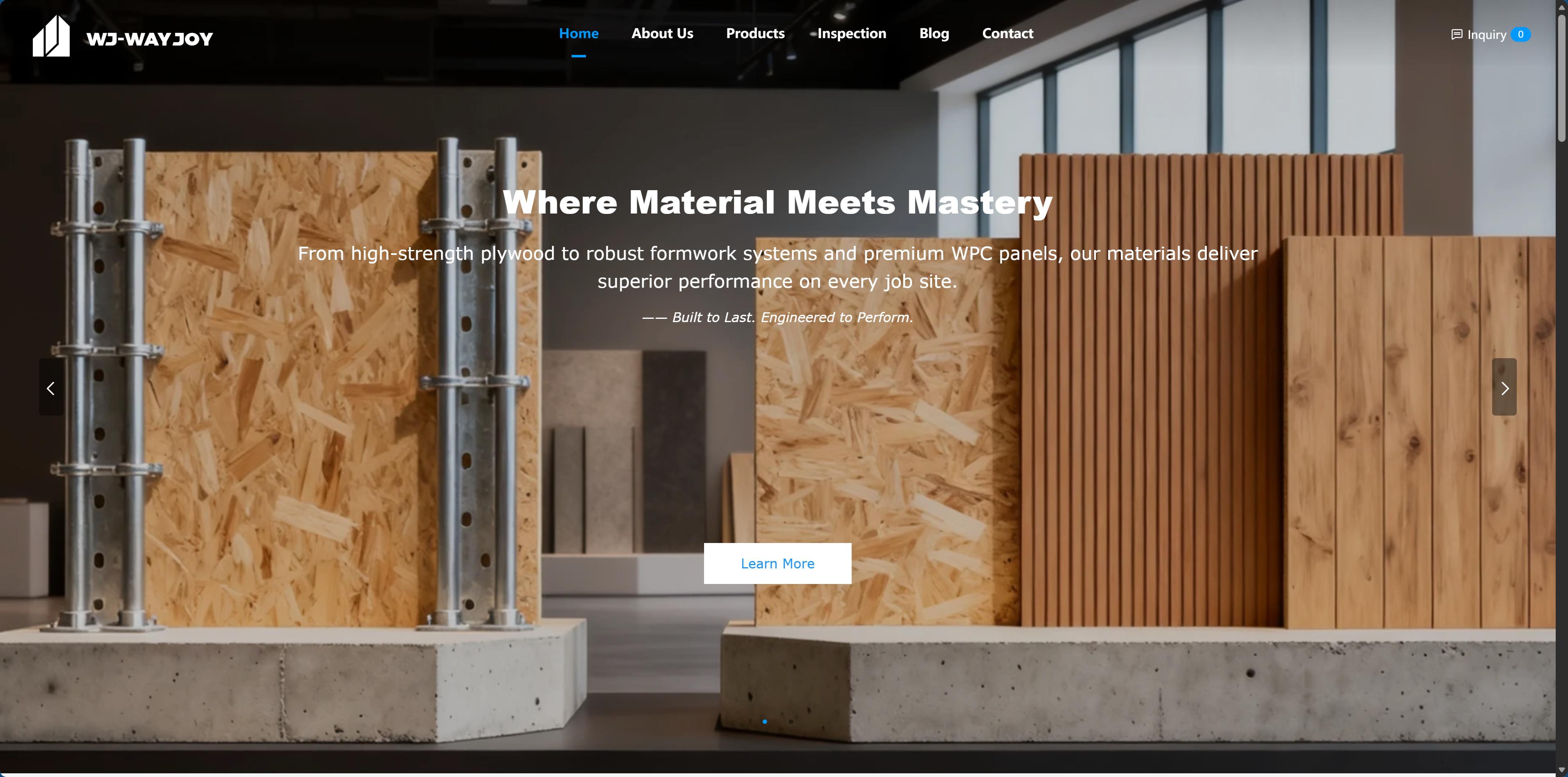
The first screen doesn’t talk about scale; it talks about construction sites.

One line above the fold: Where Material Meets Mastery. The next line covers the full category range: from high-strength plywood to formwork systems to wood-plastic wall panels. Then the line below: Built to Last. Engineered to Perform.

The subject isn't "we"—it's the materials, it's the job site.

This is a characteristic of the building materials category: a buyer's first judgment isn't "how big is this company," but "can this thing hold up on the job site."

If the first screen leads with factory area, number of machines, and number of employees, it is answering the buyer's question in the language of the factory, with a layer in between.

wj1.jpg

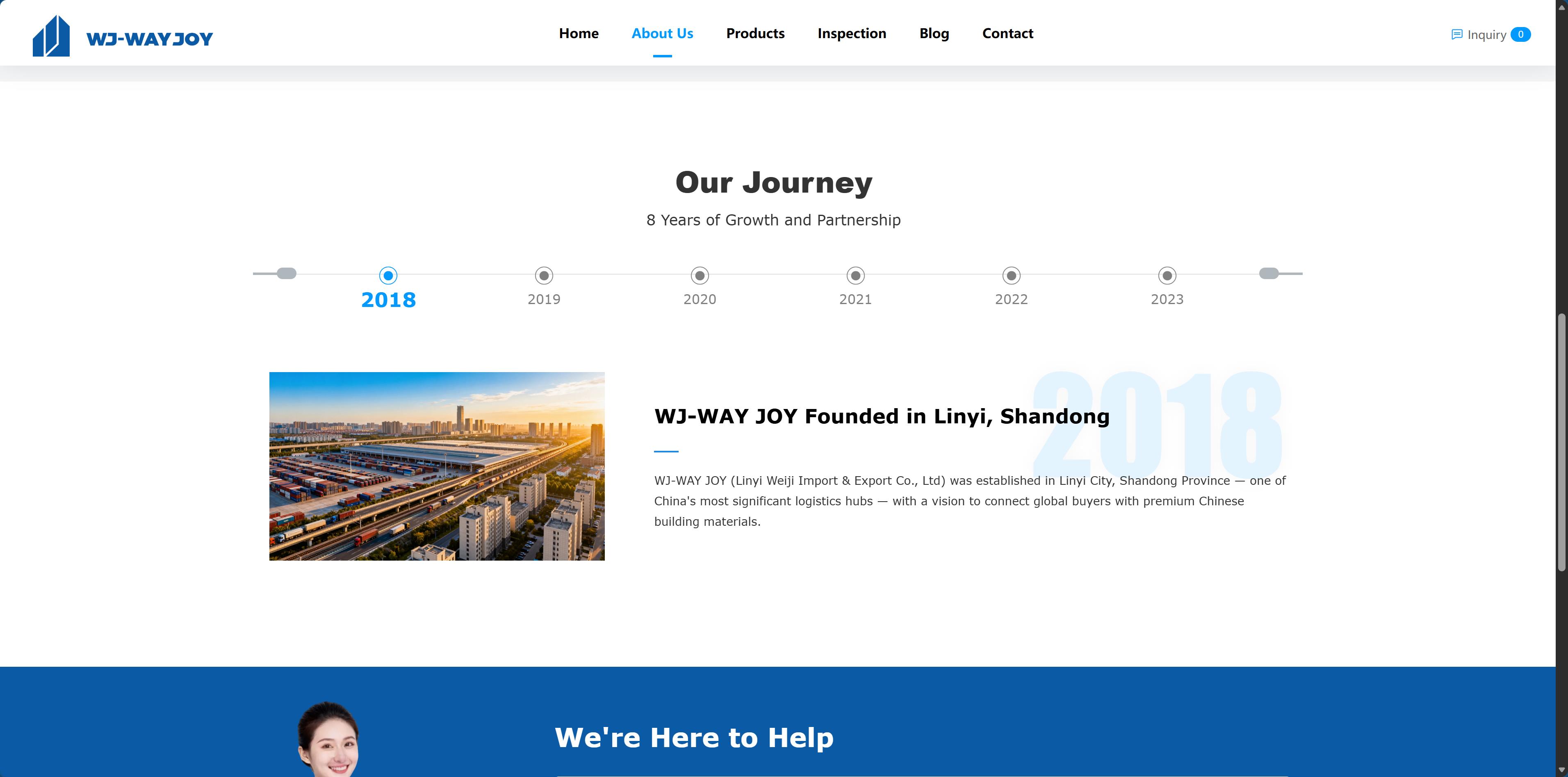
Turn inland city into an advantage

Linyi is not a port. In foreign trade, this is a question you will naturally be asked: How do you ship, how much is the freight, and how long is the lead time.

The second screen opens directly with this point: Bridging China's Finest to the World. First, state the location—Linyi, one of China's logistics hubs and home to a plywood industry cluster; then explain the transport efficiency and freight advantages brought by its geographic location.

The same fact: avoid it and it is a weakness; write it out proactively and it is supply chain capability.

For inland cities doing foreign trade, the biggest taboo is to avoid logistics in the “About Us” section and wait until a customer inquires to explain it. Buyers will not ask a second time.

wj-wl.jpg

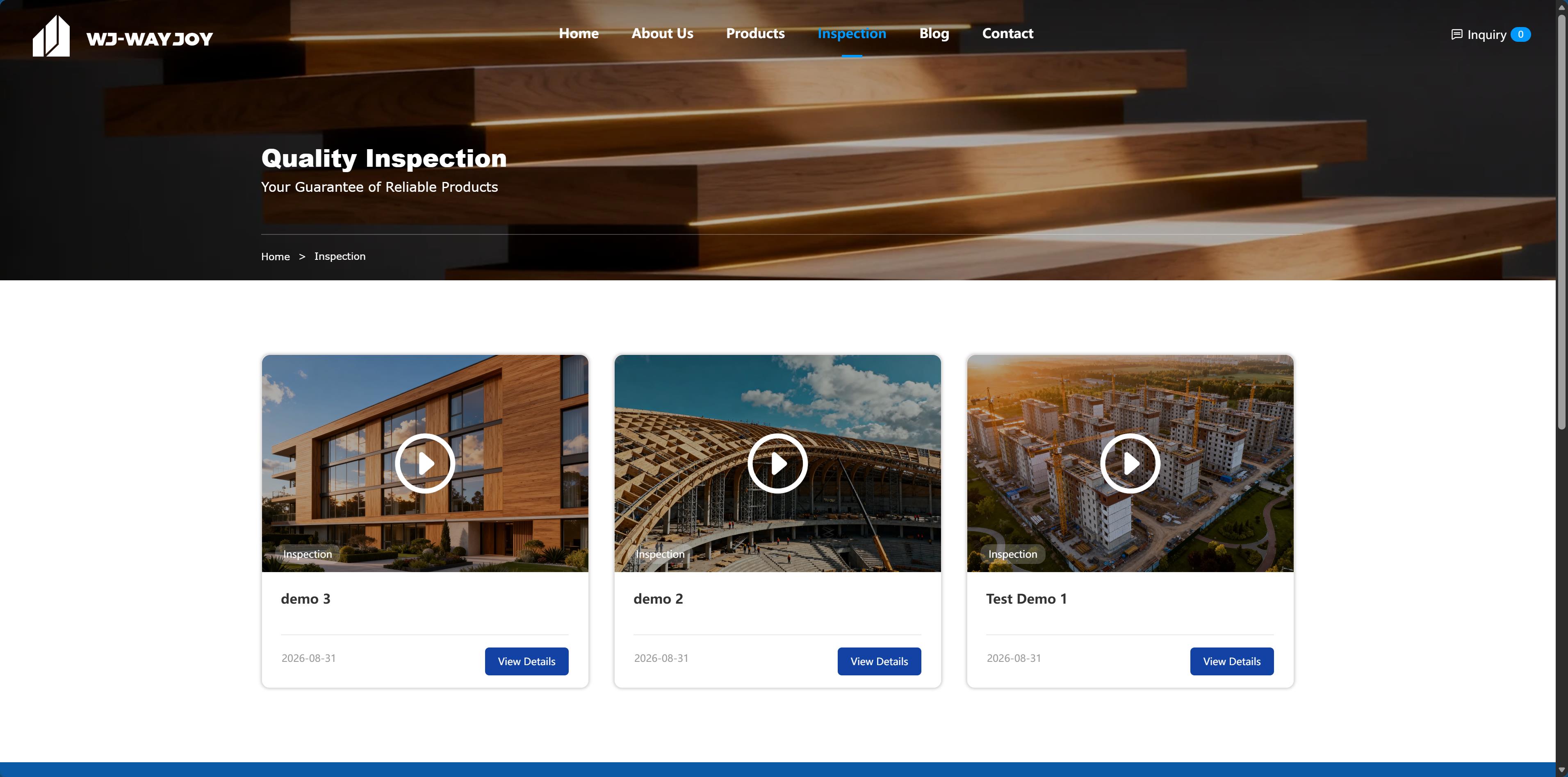
Quality inspection should not be hidden under services.

The biggest pitfalls in building materials foreign trade are not pricing, but goods not matching the sample, inconsistent batches, incorrect moisture content, and wrong glue grade.

That is why this site pulls quality inspection out of "Our Services" and makes it a standalone top-level section: Inspection.

The difference between a top-level section and a paragraph is huge: a paragraph is a promise, while a section is a workflow. Click in and you can see what is inspected, how it is inspected, and how issues are traced—the CAPA after-sales in the second half completes this process.

Similar sites often list quality inspection as the second advantage: "Strict quality control system." Every peer writes this sentence, so it is as good as not written.

wj-ins.jpg

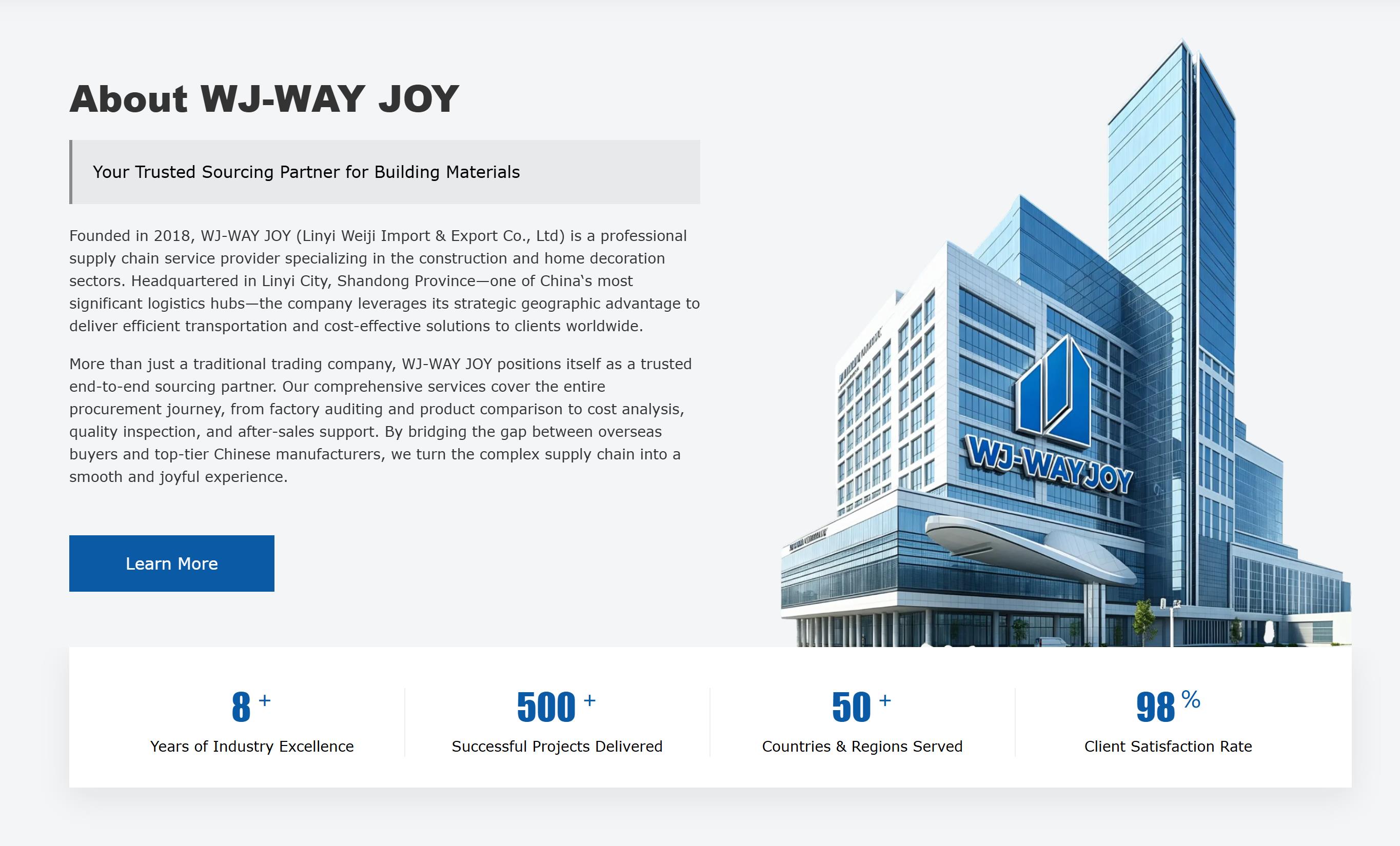
Four numbers, corresponding to four kinds of questions.

Before the About Us section, there were four sets of numbers: 8+ years, 500+ projects, 50+ countries, and 98% customer satisfaction.

The four numbers are not padding; each answers a question: How long have they been doing it? How much have they done? Where do they cover? Are customers satisfied?

The fourth uses 98%, not 100%. That actually makes it more credible—overseas buyers have seen perfect scores too many times and know they are written, not real.

Placement also matters: it is placed before the company story so people first get a sense of scale, then read the narrative.

wj2.jpg

English is not produced by translation.

The main headline on every screen is a short phrase with no explanation: Where Material Meets Mastery / Bridging China's Finest to the World / Built to Last. Engineered to Perform.

This kind of sentence has one characteristic: it only makes a statement, without explaining itself. When translated into Chinese, it often becomes "We are a professional supplier committed to providing high-quality plywood..."—turning the information of seven words into thirty.

The most common failure of foreign trade websites lies right here: the Chinese strategy is written well, but the English is translated at delivery. Overseas buyers can tell in three seconds that "this is a Chinese factory's website," and then close it.

The correct order is to first define the English tone, then fill in the content.English is the homepage; Chinese is the notes.

wj4.jpg

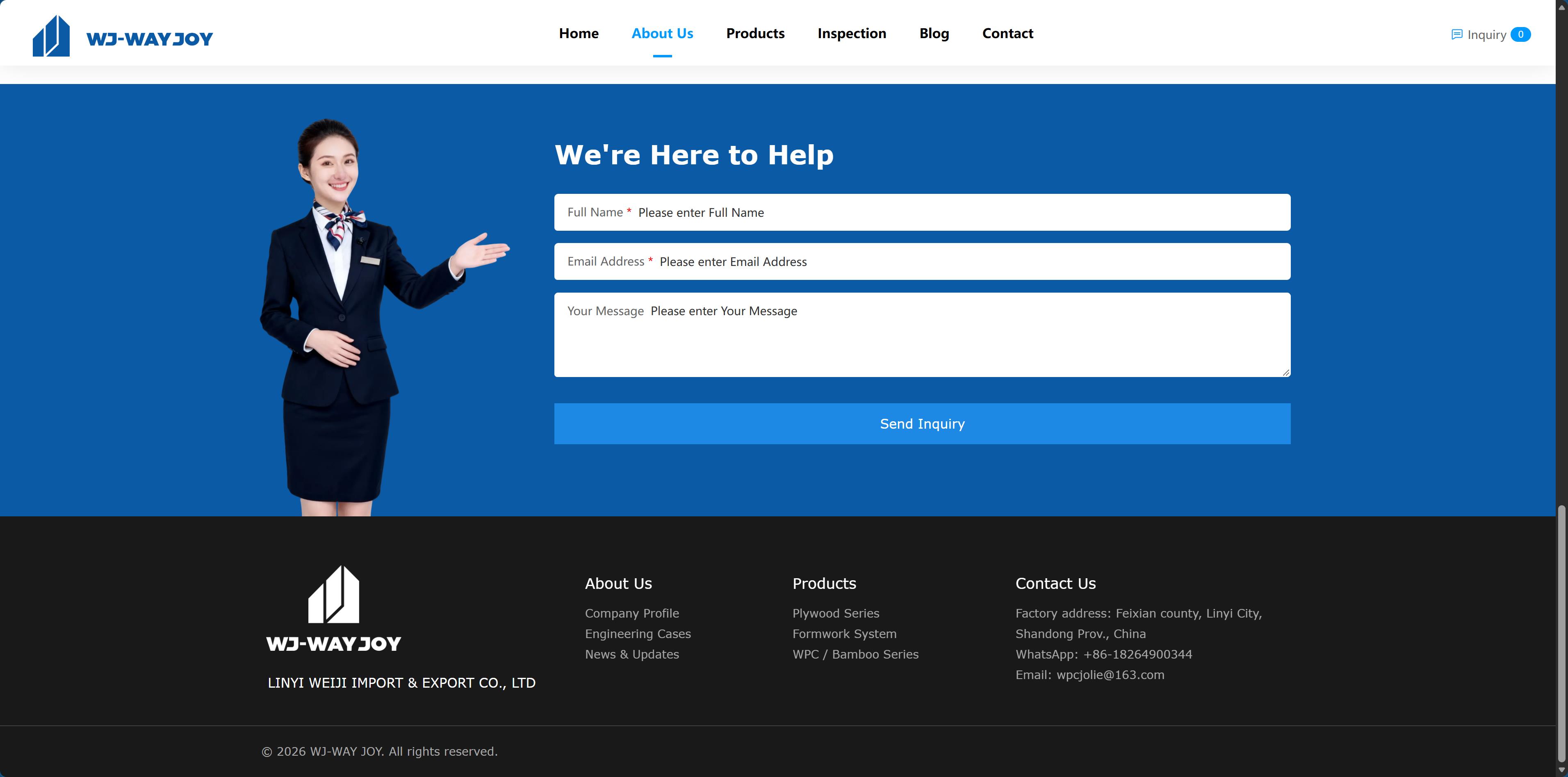
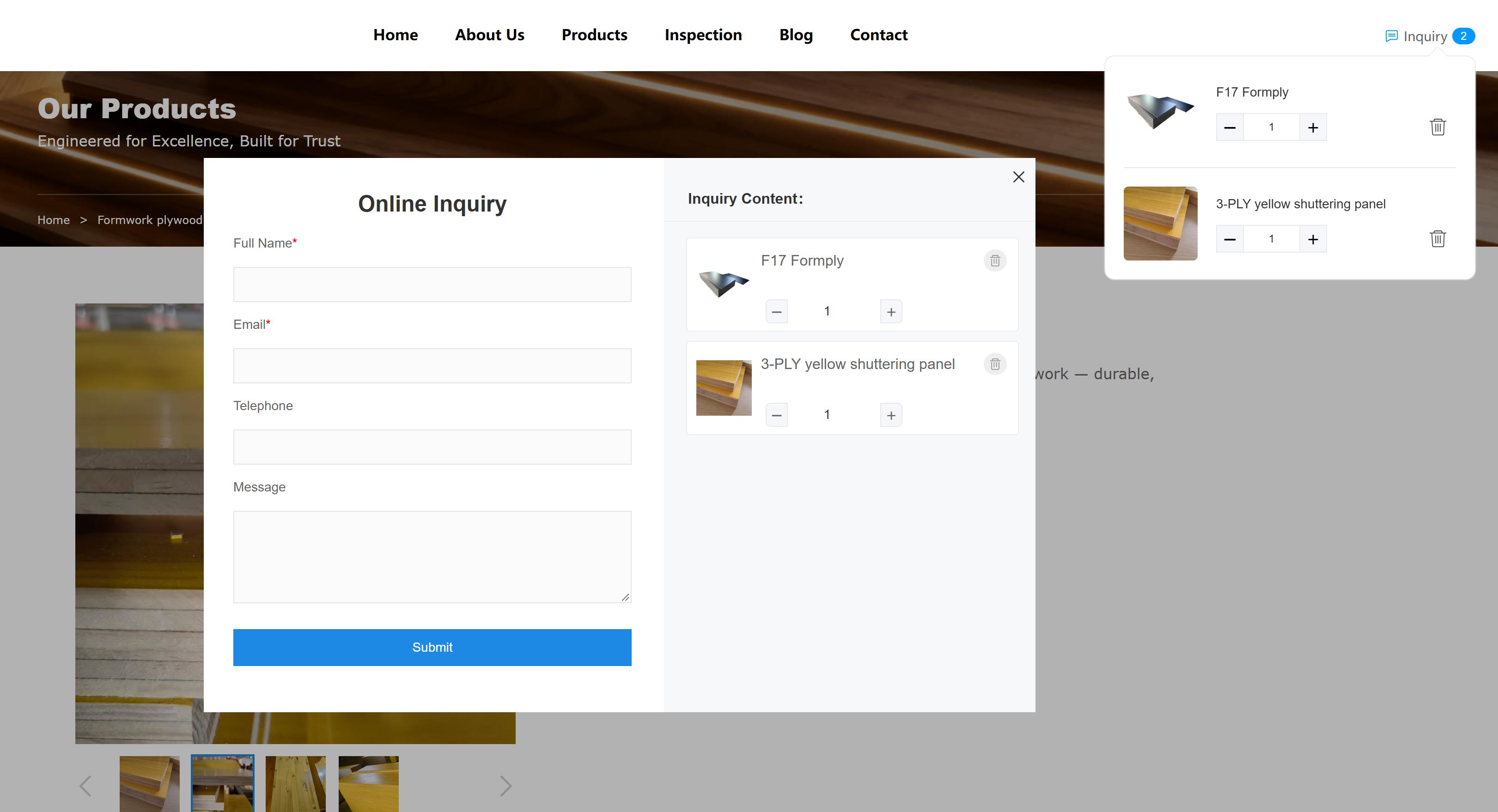
Inquiry entry, designed around the principle of asking anytime.

A persistent Inquiry entry point sits on the right side of every page across the site; when opened, it has four fields: name, email, phone, and message, plus a CAPTCHA.

Foreign trade inquiries have a characteristic: buyers compare five or six suppliers at the same time; whoever lets them fill in one fewer field gets one more question from them. The more fields there are, the higher the abandonment rate.

Four items are enough—company name, purchase volume, target market, and so on can be asked in the first reply.

Mobile needs separate consideration. A large number of building materials buyers come from the Middle East, Southeast Asia, and Africa, where mobile phone usage is high; a single-column form, buttons large enough, and no horizontal scrolling are the part most easily overlooked when building foreign trade sites in China.

wj-iquip.jpg